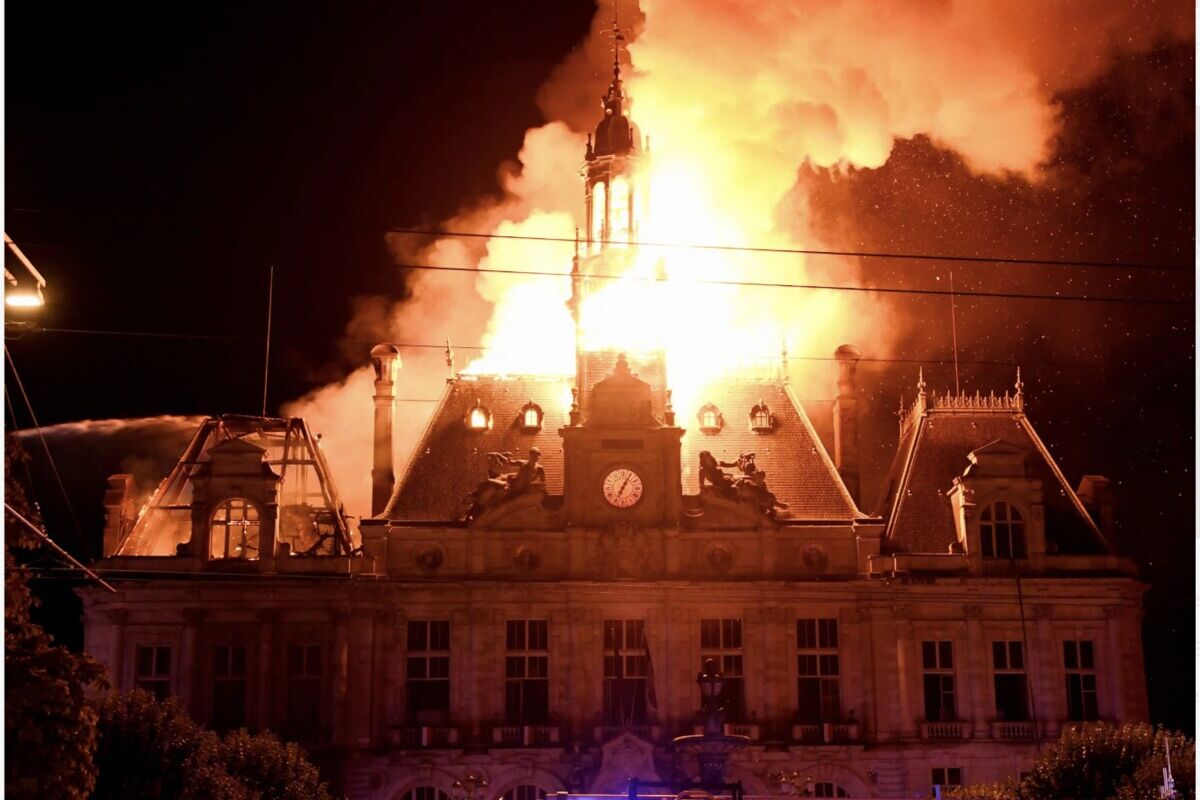
Limoges, France — 17 October 2026. A fire set amid nationwide unrest devastated the historic municipal building and its clock tower. Reuters reported that a masked mob torched the building.
Special Report by Nick Guarino
21 October 2026 |
1. Executive perspective
France faces a serious test of public confidence: violent riots, public-sector strains, deep deprivation in particular urban neighborhoods, and difficult fiscal choices. The October 2026 disturbances were not simply another episode in a single uninterrupted riot. They belong to a longer history of unrest, including the 2005 suburban disturbances, the Yellow Vest protests beginning in 2018, and the destructive riots of 2023. What connects these episodes is recurring public anger about representation, policing, purchasing power, public services and opportunity.
France has promised more than its institutions can consistently deliver, especially in its poorest communities. Mass migration has been a financial disaster for France and many other countries. As well meaning as people in power are the reality is It has broken the economy. The breakdown in social services, medical, education and the job market has caused the unrest and social institutions in collapse. Mass out of control immigration has created inequality, criminal violence, educational failures and fiscal deficits spiraling out of control.
2.1 | A weekend of fire: what happened in October 2026
Mass demonstrations on 17 October began around high living costs and deteriorating services, especially school conditions. Most participants demonstrated peacefully. In several cities, violence followed, including attacks on police, vehicles, shops and municipal buildings. Reuters reported incidents in Paris, Marseille, Lyon and Limoges; subsequent Associated Press coverage described local curfews and roughly 2,400 arrests following the weekend. Reports estimate approximately 3,000 businesses affected by looting or damage.
The burning of the nineteenth-century town hall in Limoges became an especially resonant symbol of the violence: damage to shared civic heritage, not merely to private merchandise. Reuters reported destruction of its roof and clock tower. A graphic of the destruction of a civilization by the barbarians.
Paris police introduced overnight restrictions in selected districts, and other municipalities imposed targeted curfews. France had not declared nationwide martial law yet. The difference between localized public-order restrictions and martial law is consequential. The Guardian, Associated Press and Reuters each documented evolving restrictions and enforcement measures between 17 and 20 October. As stated earlier France has not declared martial law but has ordered the army into many cities.
News reporting also identified damage to retailers and theft of valuable goods. Rioters and Looters were not seeking food or basic necessities. But attacked Luxury retailers like Gucci and Rolex locations.
3.2 | Ten years of unease as society deteriorates
Recurring unrest deserves a timeline so you can understand these are long standing issues. In 2018 the Yellow Vest movement focused heavily on fuel costs, taxes and social inequality. The riots of June–July 2023 followed the police shooting of teenager Nahel Merzouk during a traffic stop and raised issues of policing, exclusion and youth anger. October 2026 followed protests over school conditions and living costs. The immediate triggers are the same. Mass immigration of people who are coming from oppressive regimes have been reduced to savages.
The French Senate’s inquiry into the 2023 riots recorded 2,508 buildings burned or damaged, including 243 schools and 105 town halls, along with 12,031 burned vehicles. It described more than 1,000 businesses vandalized or looted and almost €1 billion of total property damage. These are 2023 totals. The full report of the present riots are not in yet. But it’s far worse!
4.3 | Too Much of a Good Thing
France has a long humanitarian tradition of offering refuge, healthcare, education and legal protections to people fleeing persecution or seeking opportunity. Generosity can become a difficult promise when fast-growing demand meets slow-moving supply and ends up destroying your society in the process. But there is a critical analytical distinction between a service being strained in a high-poverty district and immigration being the cause of that strain. French-born people, descendants of migrants, new arrivals and longtime residents all use and contribute to public services. Their situations differ dramatically.
The test is administrative capacity, can you deliver the social services you promised to the teeming masses you are letting in : classroom places, teachers, social housing, language instruction, medical appointments and pathways into employment. There is also a fiscal question—how quickly people secure work, what taxes they pay over their lifetimes, what benefits they qualify for and where the investments occur. The national accounts show immigration costs are a significant driver of a growing national deficit and the collapse of government institutions.
5.4 | Immigration: what the numbers actually count And forget to count
INSEE defines immigrants as people born abroad with foreign nationality at birth; some subsequently become French citizens. In 2024 about 7.6 million immigrants lived in France excluding Mayotte, equivalent to 11.2% of the population. That is a resident stock, not the number admitted during the preceding decade. Counting descendants born in France as new migrants would also be incorrect. And illegal immigration is not recorded in these numbers. The real number is closer 14 million people or 20% of the population.
INSEE’s revised arrival estimates recorded 234,000 immigrant arrivals in 2006, 307,000 in 2019, 246,000 in 2020, 375,000 in 2022 and 347,000 in 2023. The COVID disruption and subsequent rebound are visible in the chart. The figures measure arrivals under INSEE’s statistical definition; they should not be labeled “legal entrants” because status categories are not identical.
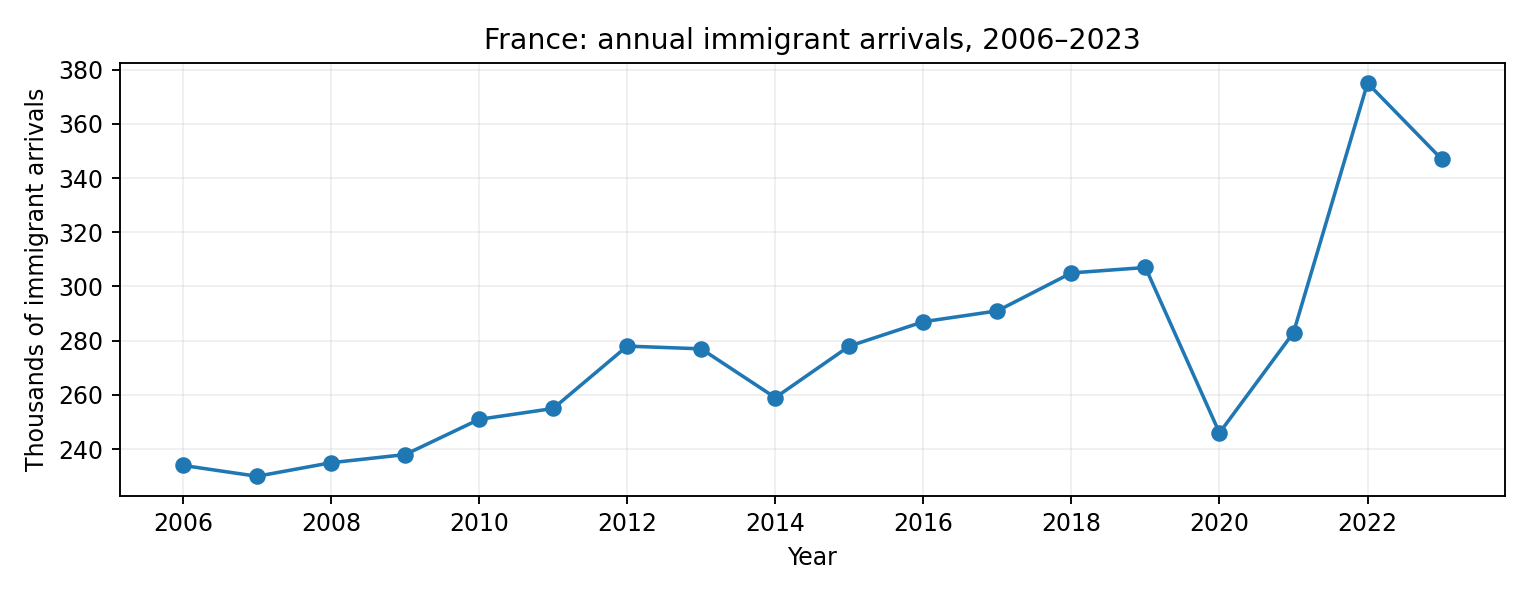
Source: INSEE, Flux migratoires, series 2006–2023; thousands of arrivals.
Country of birth is also measurable. For immigrant arrivals in 2024, INSEE attributes 7.9% to Algeria, 7.4% to Morocco and 4.8% to Tunisia; these three North African origins together account for 20.1%. Arrivals from Africa as a whole account for 45.9%. Add estimates of illiberal immigrants and the numbers swell to over 80%. These are people desperately poor uneducated who have experienced a life time of savagery, murder, rape and torture. From countries that can only be described as Muslim hell holes. Truly barbarians at the gate.
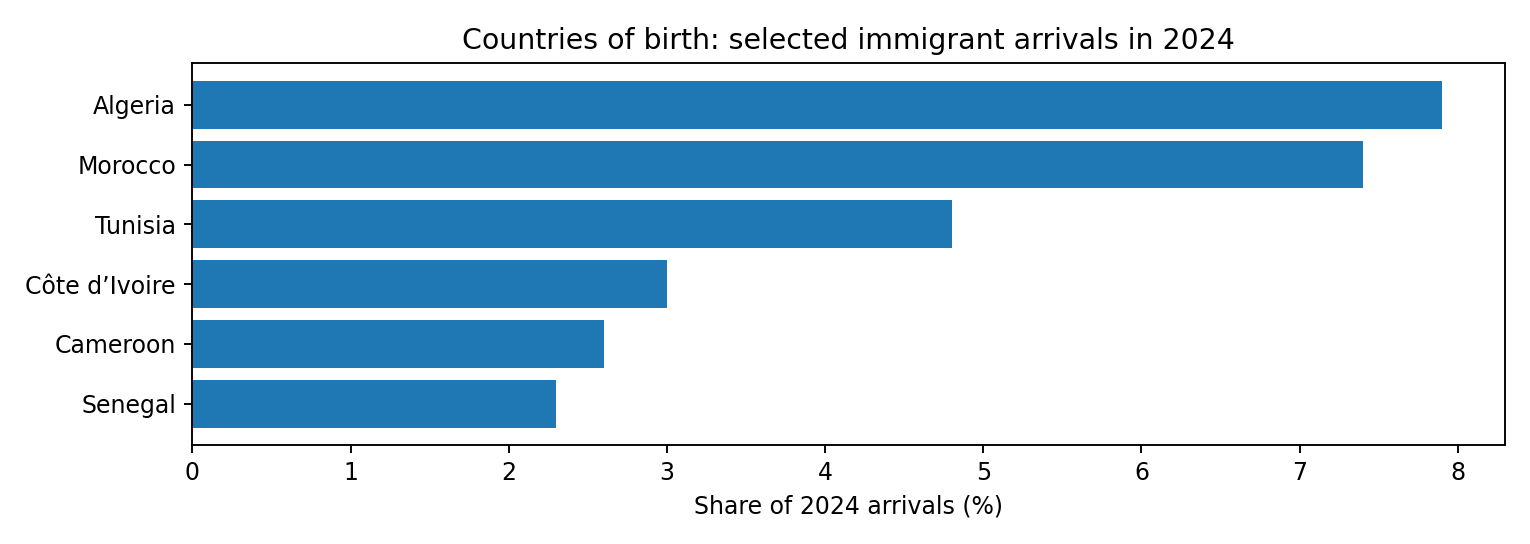
Source: INSEE, Origine géographique des immigrés arrivés en France, 2024.
France’s colonial history shaped language, family ties and migration routes, particularly for Algeria, Morocco and Tunisia. France migration policies favor countries that were formerly governed by France. Some bilateral arrangements are important, especially the special regime for Algerian nationals. Immigration pathways also vary by work, family, student, protection and EU freedom-of-movement rules.
The undocumented population which is enormous cannot be estimated by subtracting asylum applications from all arrivals. Some people apply for asylum after entering legally; some are refused; some gain status; some leave; and undetected entries are not fully observable. The Office for the Protection of Refugees and Stateless Persons (OFPRA) publishes annual asylum data, but applications and grants are different from arrivals and do not measure all irregular immigration.
6.5 | The Paris perimeter: hardship in priority neighborhoods
The Île-de-France region is not a single ring of poverty. It contains wealthy and poor municipalities, often only a short distance apart. INSEE counted about 1.7 million residents in 298 officially designated priority neighborhoods in the region, equivalent to roughly 14% of its population. Two-thirds of their households were in social housing, and about one in five economically active residents declared themselves unemployed in the population measured. The figures reveal concentrated disadvantage. I have been there they are crumbling rat infested hell holes. Run by gangs where violence, prostitution, human trafficking and drug and arms trafficking are the order of the day. The French police do not enter these buildings and neighborhoods because they are out gunned and out manned!
Many priority neighborhoods face overlapping disadvantages: older housing stock, energy costs, insufficient amenities, school segregation, lower educational qualifications, transport barriers and discrimination. Maintenance failures and shortages have real consequences for ordinary families. The appropriate questions are concrete: how many apartments need renovation, what is the waiting list for social housing, what is teacher turnover and what are local primary-care access times? And where is the money going to come from.
7.6 | Public finances: a narrowing margin for error as they run out of money
France’s fiscal position is constrained. INSEE reports a general-government deficit of €152.5 billion in 2025, or 5.1% of GDP, down from €169.1 billion and 5.8% of GDP in 2024. Debt nevertheless increased from 112.6% of GDP at end-2024 to 115.7% at end-2025 under the revised national accounts. A falling annual deficit and rising debt can coexist. A claim that the deficits are out of control can be proven. The facts speak for themselves.
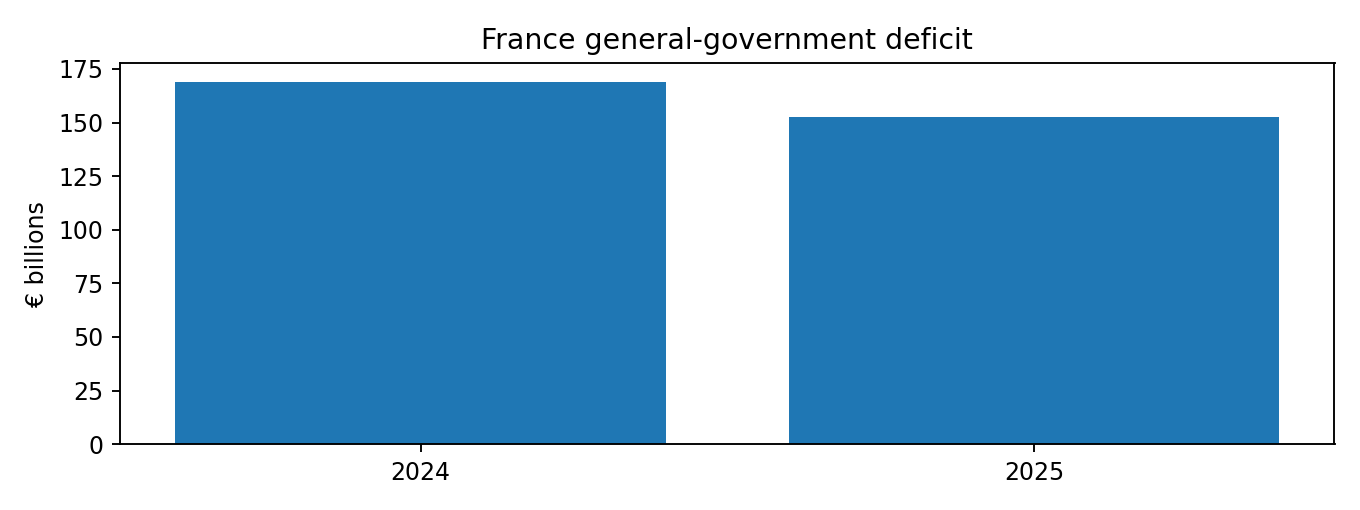
Source: INSEE national accounts, May 2026 revision.
Interest costs, aging, defense, energy and healthcare needs, and constrained tax capacity all shape public finances crises. School investment and affordable housing are especially exposed when governments must reconcile competing priorities. Social benefits attract migrants and devastate public budgets.
8.7 | Schools, skills and the labor market
The European Commission’s 2026 country assessment highlights weak educational outcomes for disadvantaged groups, barriers to youth employment, persistent skills mismatches and child-poverty concerns. These are structural challenges France faces. By any measure this is a society in meltdown. School-building maintenance spending, staffing vacancies, pupil-teacher ratios, student mobility and performance by socioeconomic background. Swelling immigrant pupils explain a large part of the decline.
A generation that sees few credible paths into skilled work is vulnerable to discouragement. The term “skyrocketing” crises exposed by the widespread riots expose the consistently documented upward rise in high unemployment. Youth unemployment can be quantified by nationality, age, place of birth, school attainment and neighborhood poverty.
9.8 | Drugs, crime and legitimate public fear
Police-recorded crime provides evidence of particular offenses, we can conclude a census of offenders’ ethnic or religious identities. The Interior Ministry’s 2025 statistical assessment reported increases in registered drug-use offenses (7%) and drug-trafficking offenses (9%), while some categories such as burglaries and vehicle theft declined.
Criminal networks recruit and exploit people facing hardship, including young people, poor migrants mostly. Muslims collectively committed the majority of the looting. Victims of drug-related intimidation live in those previously described Muslim immigrant deprived communities. A responsible account describes the economic lure of illicit markets, violence, insufficient policing capacity and victimization of poor Muslim immigrants.
10.9 | The economic damage of looting
Businesses suffer costs that headline damage estimates rarely capture in full: lost inventory, broken windows, destroyed fixtures, short-term closures, foregone tourism and rising insurance premiums. A high-end boutique may be an attractive target because merchandise has resale value; other targets include supermarkets, pharmacies and independent shops. News coverage of October 2026 suggests thousands of businesses were damaged or looted. The precise mix by retail category should be tracked in police and insurer records but it’s too early. The investigations have just started.
A business can have been vandalized without having been looted, and brand ownership does not prove the destruction of a particular flagship store. This report discovered names Louis Vuitton, Dior, Celine, Gucci, Rolex and Kenzo are some of the luxury stores that were looted and destroyed.
11.10 | This societal collapse!
The evidence establishes serious deprivation in certain communities, damaging episodes of unrest, some worsening recorded offenses and substantial public debt. It establishes that France as a whole has ceased to provide public order, healthcare, education or representative government. A more rigorous formulation is that massive migration, chronic underinvestment and social exclusion have eroded trust in institutions, and that the cost of repairing the damage increases the longer governments refuse to acknowledge the immigrant crises and defer action.
The relevant measures are not only arrests and fines, but educational attainment, affordable housing, real wages, youth participation in work, access to primary care, public debt service and neighborhood safety. France as do many other countries need to deport illiberal immigrant and stop the liberal immigrant policies that have overwhelmed the very fabric of French society. If they do not social unrest, public anger and political leadership changes possible through violence will be the order of the day.
11.2 | Conclusion Beyond the flames
The Limoges fire is an unforgettable image of barbarians destroying civilization. The larger story is: families struggling with housing costs, students encountering crumbling schools, poor education levels, municipalities seeking funds for deteriorating infrastructure, merchants rebuilding storefronts, and young people looking for credible prospects. The October 2026 violence can be explained by a religion that has brought death and destruction wherever it takes root. Immigration in mass of people with no education, skills and who are savages with a culture of barbarianism. The challenge for France is whether its elected leaders can reverse immigration policies, restore institutional capacity while preserving public safety, opportunity and lawful humanitarian commitments that do not exceed its capacity to deliver.
13. Sources and research notes
1. Reuters (17 Oct 2026), Mass protests in France spiral into worst riots in years
https://www.reuters.com/world/students-trade-unions-yellow-vests-set-protest-across-france-2026-10-17/
2. Reuters (18 Oct 2026), Limoges fire-ravaged town hall
https://www.reuters.com/world/frances-limoges-fire-ravaged-town-hall-rekindles-memories-notre-dame-2026-10-18/
3. Associated Press (19 Oct 2026), Paris curfews
https://apnews.com/article/75825aafc5412ae389c6d41443b4082e
4. Associated Press (20 Oct 2026), Curfews bring calm
https://apnews.com/article/13189fcb1481614dc65c2125deb8333d
5. The Guardian (19 Oct 2026), France protests live reporting
https://www.theguardian.com/world/live/2026/oct/19/europe-france-protests-riots-macron-ukraine-russia-zelenskyy-sweden-latest-news-updates
6. INSEE, Flux migratoires (2006–2023)
https://www.insee.fr/fr/statistiques/8570316
7. INSEE, Geographical origins of arrivals in 2024
https://www.insee.fr/fr/statistiques/2861345
8. INSEE, Immigrants and descendants (2024 population)
https://www.insee.fr/fr/statistiques/8612512
9. INSEE Île-de-France (2024), Priority neighborhoods
https://www.insee.fr/fr/statistiques/8240964
10. INSEE (May 2026), 2025 public accounts
https://www.insee.fr/en/statistiques/9008766
11. French Senate, June 2023 riot inquiry
https://www.senat.fr/rap/r23-521/r23-5218.html
12. French Interior Ministry (2026), 2025 crime report
https://www.interieur.gouv.fr/actualites/communiques-de-presse/insecurite-et-delinquance-en-2025-bilan-statistique-et-atlas-departemental
13. European Commission, France country report
https://economy-finance.ec.europa.eu/economic-surveillance-eu-member-states/country-pages-including-country-reports/country-report-france_en
14. OFPRA, 2025 asylum statistics release
https://www.ofpra.gouv.fr/actualites/rapport-dactivite-2025-publication-des-donnees-sur-datagouvfr
Editorial/source note: Statistics use their published reference period, which is not always October 2026. Claims of nationwide martial law, a ten-million-person decade of illegal immigrant arrivals, and confirmed destruction of luxury retailers like Gucci or Rolex outlets have not been corroborated just yet. We are sure final reports and investigations will support these allegations.